RFP & Terms of Reference Build-Up
Translate business and technical requirements into clear, structured procurement documentation that vendors can price and the organization can evaluate.

KBSOFT/Services/Technology Consulting
Consult · Technology Consulting
Seven consulting services that take a leadership team from business direction to a technology roadmap it can fund, govern and execute. Each engagement answers the same three questions.
Current state: architecture, processes, capabilities, technology, costs, readiness.
Target state: business requirements, capabilities, operating model, architecture, priorities.
Execution roadmap: initiatives, dependencies, investment, governance, timeline, accountability.
Strategy becomes valuable when the organization knows what to do next.
Seven consulting services
From defining a long-term ICT strategy to preparing for enterprise transformation, KBSOFT provides consulting capabilities across the technology lifecycle.
Digital Transformation Consulting
Digital transformation is more than introducing new systems.
KBSOFT helps organizations determine where digital technologies can improve customer experience, operating efficiency, decision-making and new business models.
We help leadership teams translate transformation objectives into a structured program connecting technology, processes, people and organizational change.
Why KBSOFT?
According to McKinsey, BCG, KPMG and Bain & Company, the risk of transformation failure falls somewhere between 70% and 95%.
We deliver a risk-free transformation journey.
Digital experiences and engagement.
Automation and process modernization.
Better access to information and decision support.
Technology-enabled products, services and revenue opportunities.
ERP Readiness Assessment
ERP transformation affects processes, organizational structures, data, governance and the way teams work.
Before committing significant capital to implementation, organizations need to understand whether they are actually prepared for the transformation.
KBSOFT's ERP Readiness Assessment evaluates the conditions required for successful implementation across seven dimensions, and states plainly which ones need work before a vendor is selected.
Understand readiness before committing to implementation.
Business Capability Build-Up
Business capability mapping provides a stable view of the organization independent of specific systems or departments.
KBSOFT maps technology applications against named business capabilities to reveal where technology is supporting the organization effectively, and where gaps, duplication or outdated systems remain.
Business capabilities
Application landscape (illustrative)
Hover or focus a capability to reveal its supporting applications. Corner markers indicate duplication, legacy constraint or investment opportunity; dashed boxes are gaps.
Capabilities without sufficient technology support.
Multiple systems performing the same function.
Legacy applications that constrain future capability.
Areas where technology investment could create additional value.
See the technology landscape through the lens of the business.
Instrumentation & Automation
KBSOFT designs, installs and services the instrumentation and control systems that automate industrial operations.
Working as a system integrator and specialized automation contractor, KBSOFT acts as the bridge between equipment vendors and end-user facilities: oil refineries, water treatment plants, power grids and manufacturing facilities.
Every engagement covers the full control hierarchy, from field instrumentation and real-time control logic to supervisory systems in the control room, so that the plant operates safely, reliably and with the data its operators need.
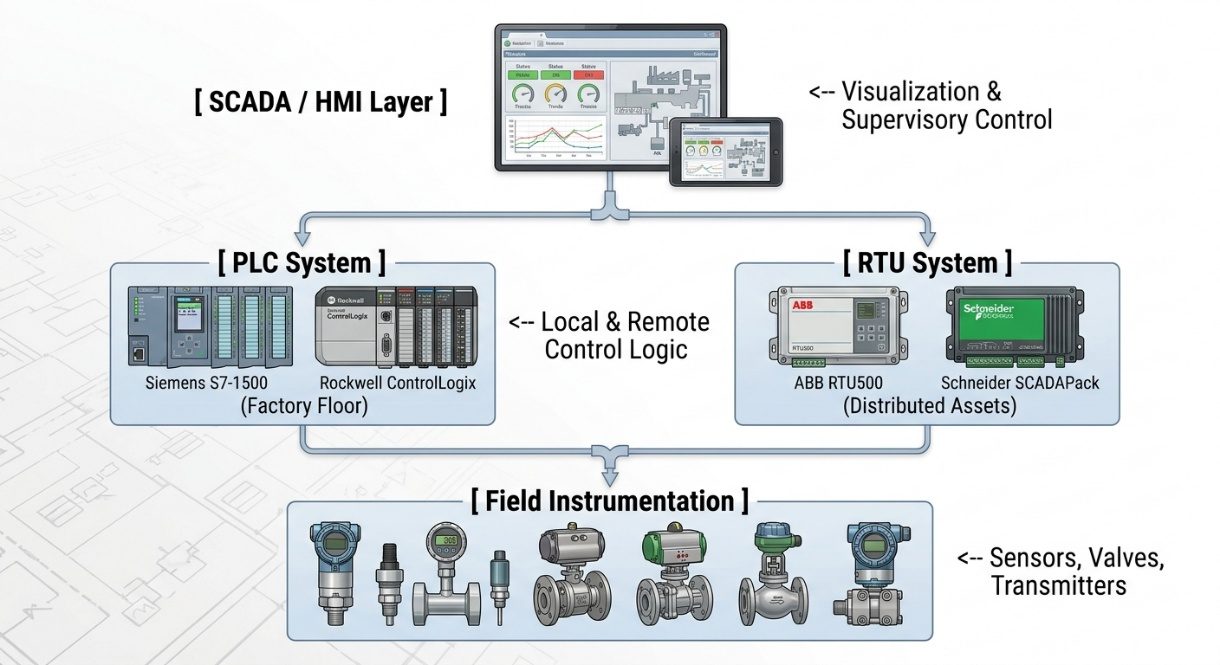
What KBSOFT delivers
Industries served
ICT Master Planning
KBSOFT develops ICT Master Plans that connect an organization's business direction with its future technology environment.
The engagement evaluates the current enterprise architecture, identifies gaps and dependencies, prioritizes technology initiatives and establishes a structured roadmap for future adoption.
The objective is not simply to modernize technology. It is to ensure investment is directed toward the capabilities that create the greatest organizational value and return.
Understand existing infrastructure, applications, architecture and technology dependencies.
Define the technology environment required to support future business needs.
Identify which technology initiatives should happen first, and why.
Establish a realistic phased path from the current state to the target state.
Connect proposed technology investment with measurable business outcomes.
Held together by dependencies, investment gates, risk controls and business outcomes.
Roadmap horizon typically 3–5 years · sequenced by value, dependency and readiness. ROI aligned to each phase.
IT Consulting
Focused engagements that help organizations structure major initiatives, improve the performance of IT functions and reduce execution risk.
Each capability below can be engaged on its own or combined into a single program of work, typically anchored to one consequential decision the leadership team has to make.
Translate business and technical requirements into clear, structured procurement documentation that vendors can price and the organization can evaluate.
Governance and management structures for complex technology initiatives, so that delivery stays accountable to the business case that funded it.
Prepare the organization, not just the technology, for transformation.
Define how the IT organization should operate to support the business: who decides, who delivers and how services reach their users.
Understand where technology expenditure creates value and where it does not, then improve efficiency while protecting strategic capability.
Organizational resilience consulting: prepare for disruption before disruption occurs, starting from business impact rather than backup technology.
Translate business requirements into a coherent technology architecture that connects business capability to the applications, data and technology that support it, with integration and security designed across every layer rather than added afterwards.
From advice to execution. Where a decision leads to a tender or an implementation, KBSOFT can manage and deliver the project under contract.
Technology Capability Outsourcing
Organizations do not always need permanent internal teams for every technology discipline.
KBSOFT provides access to experienced technology professionals and specialist capabilities that can complement internal teams, support strategic programs and address temporary capability requirements, with the same consulting standard applied to how the capability is scoped, governed and handed back.
Specialist professionals working alongside internal teams, inside the organization's own governance.
Expert capability supporting specific strategic initiatives, from business case to decision.
Additional expertise for transformation and technology programs, scaled to each phase.
Access capabilities that may not justify permanent internal headcount: architecture, security, data, PMO.
Looking for the full resourcing service? Engagement models, available disciplines, certifications and a resource request form are on the dedicated page.